Friday, 6 July 2018

Building alliances between IDAHOT and MaputoProtocol@15 for womxn


IDAHOT:
The international Day Against Homophobia Transphobia and Biphobia

Maputo Protocol:
Protocol to the African Charter on Human and Peoples’ Rights on the Rights of Women in Africa

Womxn:
No set definition. This term, as used in this piece, refers to a broad still unraveling category of persons of female gender who voluntary identify, live, express their gender crossing stereotypical roles and standards, embracing her several cross-cutting circumstances and layers of identity, recognizing the humanity and diversity in her community, operating, demanding, believing in and working towards the substantive equality(equity) of all sexes and genders and against the repressive confines of the poisonous glorification of masculinity at the expense of the human rights of persons of female gender in all spaces. A feminist.


People around the world celebrate IDAHOT annually on May 17 to mark the ‘de-pathologisation’ of same-sex attraction in 1990. 28 years later, in 2018 the African continent celebrates the 15thanniversary of the emergence of the Maputo Protocol, Africa’s regional articulation of the human rights of persons of female gender taking particular cognisance of the African context. Theme for IDAHOT this year is ‘Alliances for Solidarity’, focusing on the important collaborations that have been and need to be forged in laws, policies, theories, practices, movements and relationships in order to foster cut-throat progress in the advancement of human rights, particularly the protection, promotion and fulfilment of the human rights of LGBTI persons. Linking the Maputo Protocol, IDAHOT and their camps as allies I believe is a match made in heaven for the aid of vulnerable groups such as womxn.


In 2015 Caitlyn Jenner rocked most of the world by stepping into public glare to broadcast her transitioning from the widely celebrated athletic and ultra-masculine Bruce Jenner to the now sultry, unsettling, ‘who-do-you-think-you-are’; gracefully disruptive sensation Caitlyn Jenner. ‘This is taking gay to a whole new level!’ the world may have thought- I may have thought so too at the time. Some distance away from Caitlyn’s situation, in spaces like East and West Africa – and even some parts of the South- the noose was tightening legally around persons of same-sex loving sexual orientations and socially around anything that connected to or smacked of derogation from the glorification of heterosexuality and stereotypically set expressions of gender.


At home in Nigeria, it was such a heated time, it is still very heated at the moment. In some parts of Nigeria, actual or perceived homosexual sexual orientation could land persons and groups serious beatings, lynching, unlawful arrests, public humiliation in the media and even death. The flame of this homophobic inhumanity is fanned by the media, pop-culture, religious and political leaders. In South Africa, where I now reside, where the laws are progressive and the expectations are high, there are still recurring incidents of homophobic human rights violations.


Unfortunately, because the general and uninformed impulse is to flatten everything that is not heterosexuality to homosexuality, this translates to lived realities getting several times as hard and repressed for womxn, for the multiple reasons that: they are persons of female gender; they cross de-glorifying constructs of socially and culturally set standards of femininity and poisonously glorified masculinity in all spaces; there is often a strict expectation that womxn should not be doing the latter; womxn breaching this expectation is perceived as highly offensive and threatening by persons and systems of authority. As if regular gender inequality was not bad enough, womxn deal with recurring and increasing degrees of gender-based violence, domestic violence, rape, humiliation at work, school, places, of worship, policing of their femininity, their views, careers and bodies. In a greater part of the continent, womxn on a daily basis deal with shocking levels of human rights violations.


In several African societies, there are a thousand and more shades of womxn or persons perceived to be womxn. These range from persons of female gender who choose to wear trousers and not skirts to persons who wear a darker shade of lipstick than others; dying their hair a colour/shade or two varying from the default ; pierce more than one hole on an each ear for jewelry or pierce multiple holes around their body; having tattoos; stubbornly insisting on going to school; pursuing a career as opposed to involuntary staggering into marriage; not being interested in marriage at all; having a deeper note of baritone than is permissible; being sexually and romantically inclined or attracted to or involved with other persons of female gender; having social, genetic, genital or physical features that are outside poisonously glorifying masculine expectations of what a person of female gender should be. But this is not the only problem.


In 2017, Chimamanda Ngozi Adichie, award winning Nigerian author whose feminism is often woke, made the controversial statement ‘Transwomen are transwomen’. This earned her so much hostility. She subsequently explained that she meant to say that transwomen are separate category with unique experiences from naturally cisgender women. More interestingly this controversy highlighted the argument that more often than not feminism is largely pegged on the tokenisation of female persons whose gender identities and expressions are reasonably within the scope of tolerance of the masculine glorifying structures, enough to matter as the majority of persons of female gender , and often as the only persons of female gender that count.


Generally, in most African societies and at the regional level, womxn do not fall within this scope of tolerance as such they have been unjustly excluded from the broad and open conversations on gender and human rights. Contrary to Chimamanda’s inclinations of separating the different struggles in order to keep them all in focus, the plight of womxn have been separated and ignored. Separation has not worked. Perhaps this is because gender and human rights on the African continent still generally caters to poisonously glorifying masculine standards.
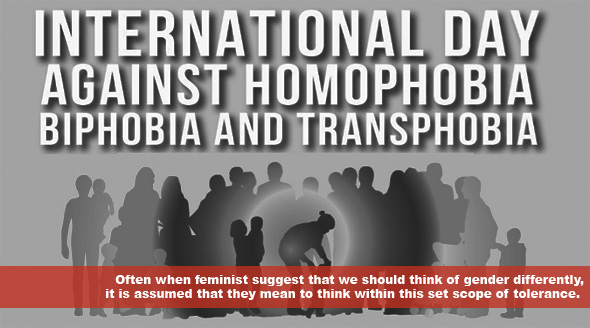


Often when feminist suggest that we should think of gender differently, it is assumed that they mean to think within this set scope of tolerance. The wide resistance to the observer status of the Coalition of African Lesbians (CAL) should also have been perceived as a bold and unjust resistance to the substance of the Maputo Protocol and the human rights of persons of female gender on the African continent. A resistance that all persons of female gender, and everyone else should recognise as a disappointment and threat to human rights and democracy.


The Centre for Human Rights recognises this resistance and is presently working on a visual campaign with the theme of ‘Transwomen are women’ to mark the 15th anniversary of the Maputo Protocol. This campaign argues for respect for diversity and the recognition of the plight of womxn as part of the major issues that concern persons of female gender on the African continent. This is because a person of female gender is never just one thing. This campaign encourages that the articulation, policy making, law making, activism and positive practices around the human rights of persons of female gender be enriched to include and cater for the human rights and specific identities and realaties of womxn as well. The stars align in Africa, allying IDAHOT and MaputoProtocol@15, we need to think and work inclusively, progressively and productively for all persons of the female gender; nobody should be ignored. Nobody should be left behind.


(Originally punblished on: https://africlaw.com/2018/05/18/building-alliances-between-idahot-and-maputoprotocol15-for-womxn/ )

Friday, 9 February 2018

'Unbeautiful', Njo!

Sometimes it invades me like fever
'Unbeautiful',  'Njo!' I feel it.
It comes at night to assault me
His arms are cold and infuses me with sadness
I can't sleep
No one at home can sleep
My bed creaks 
I pace about restlessly in my mind
I hear words and faces are formed in the virtual clay of the dark
I see pictures even
'Unworthy', how can I forget?
Then the morning comes
And I emerge like I'm happy, who doesn't
I forget that I'm pretend, I believe, faith
There isn't a reason not to be
But I'm ashamed
I'm deeply ashamed
I can't tell anyone
They hear the creaking beds not my screaming
'Unneeded' 'such a waste'
The whispering never stops in my head and in the corridors
I've failed at 'boyhood'
I've failed at 'manhood'
There is nowhere to run to
The floor has denied me a funeral
The sun blares overhead
The heat is lethal
It hurts me, us
And when it rains, it floods
It floods cold puddles of tears
It's dark only to be lit by the scary lightening that winks at my humiliation
It's bed time again
'Unbeautiful', 'Alu!' 'such a waste' 
The voices return
I can't sleep
No one at home can sleep
So we lay alive in our beds, in the puddle of tears that fell as rain 

Wednesday, 20 December 2017

Blue


Blue is the colour of denim.  It is the colour of ‘cakes’ and condoms. It is the colour of Nkosi’s charm when he twists and turns beside me. I am leaving him in the morning for Nigeria. Our Hatfield home is all I have known for the past seven months. I love it. I love him. But home is where my butt was first whipped, Port Harcourt Nigeria. It is where green is still dense and needs no artificial watering. Home is where pap is not a thick corn paste eaten with chicken but the thin akamu lapped up with sugar, milk and moi-moi. 

But blue is the colour of our bedsheets too. It is the colour of the plastic horn Nkosi wears around his neck. Blue is the colour of Nkosi’s love. The colour of the shirt he wore the day we locked glances for the first time at a cocktail bar eight months ago. I shivered because it had been cold. But I shuddered because I had never thought myself queer enough to catch anyone’s attention. But he had seen me. Nkosi had seen me and had come to me. 

Blue, the colour of my turbulent blood and the frozen time when he held me in the space between the Joe Public night club and a raging heart, kissing and tickling my ear lobes so tenderly as his caucasian un-Zulu looking fingers held my torso in place.

Blue is often the colour on the insides of my closed lids as I, stark naked, ride his lips, while he lay slabbed between and beneath me fully clothed, drenched in our sweat.  All the while, his wide pelvis oscillating gently beneath the gentle press of both his palms. All the while still clothed.  So blue. So Nkosi.

Blue, the colour of the condom he handed me just before I fucked my thirtieth birthday present while he laid back on the grey velvet sofa puffing the cigar that he lit in the flicker of the scented candle beside him. All the while laid back stringing me tightly with his eyes, his saturating presence.
Blue, the colour of the pills he swallows at 8:00pm every night just after dinner. I serve him on a glass saucer. His eyes, half shut like Garfield's after gulping them down. He regrets. But things are better. 

I am leaving him in the morning for Nigeria. It is my nephew’s christening in a few days. I have been chosen to be his godfather. This will be my first visit to Nigeria since I told my family during our monthly skype call that I like boys that much. Blue was the colour of their silence. And the colour of the screen when they all feigned poor internet signals and signed off one after the other. They had not fought me but they had avoided talking about it. Blue is the colour of the emptiness I felt, I still feel.
I am boy. ‘Blue is for boys.’ This had always been drummed into me from birth whenever I had to choose anything from a toothbrush to a shirt, anything. So everything had to be blue, a different shade of blue, but blue. Blue is the colour of everything that I have learned to cling to. Blue is my fierce pull to Nkosi, a man almost like me. Blue is my fever. 

Blue makes me cringe at the Nigerian label tibii  and makes me embrace the South African label queer. Being tibii makes me a target but being queer validates my agitation, lets me stand behind ideologies and philosophies, walls that insulate me from stones and raw homophobia. Blue makes it okay to be insulated. I am insulated. Nkosi is not. He was born with a vulva that he will let no one touch. His vulva had annoyed me in the first month. 

‘This is simply impossible!’, I thought while my car sped away the night he told me.

It had frightened me for the better part of our second month together. I could not imagine myself sharing a home or a life with it. But Nkosi…Nkosi drove me ga-ga. He drove me kpof-corns. I stayed.  I learned to stay and grow into every part of him. Not that I mind, but somehow here in South Africa it is a big deal that his blood screams of Zulu, Afrikaans and English genetic scripts yet his skin and hair are European. He wants his skin several shades darker. He is not insulated, he may never be.
 He turns and turns beside me. His face marked by last night’s tears. His lips mumbling in his sleep the last of his plight to me. He does not want me to leave. He wants to come with. He said that he has a bad feeling about my return home. He thinks that it is a trap.

 'Tope, I have a bad feelings', he says.

 He believes that he will never see me again. He cried himself to sleep when I failed at being ‘reasonable’.

I am scared of returning home. But home is where my butt was first whipped. So I am all packed and ready to hop on that plane to return to the place where I can be uncle, son, brother. These make Nigeria worth returning to. I am not scared enough to forget. I am resolved to never be that scared. At least not yet. 

Sirens blare and someone in a blue shirt screams ‘homo!!!!’ and my lids are flung apart. ‘Jesus!’
‘I’m sorry’ she texted in a Whatsapp message just before I boarded. ‘Ejike says that his son will have no cock-sucker for a godfather. I’m sorry.’  Still, I am allowed to come home. They have said nothing else. They not told me that they joined some our church members to hold private prayer sessions for me. They have not told me that they have ransacked my room in search of proof. Proof! They had not told me that they have been questioning my friends and physically attacking them whenever they visited our home. They been quiet and courteous to me. Sending me their love and blessings.
Still I am boarding the plane, oblivious of the 42 men arrested only a few months ago for homosexual charges. The plane is packed with Nigerians, mostly Igbo men like me. I can tell, they have their blue walls up claiming their space, asserting themselves in shades of blue, from cocky loud to silent deadly. Blue!
I am going home. Nkosi is in my thoughts. I am scared. As the plane leaves the ground I regret. I want to varnish. I want Nkosi.

Sunday, 17 December 2017

Because Amasa Firdaus Abdulsalam stands: An open letter to the Nigerian leadership and people requesting the unconditional call of Amasa Firdaus Abdulsalam

Dear Naija,

On 12 December 2017, a batch of Nigerian law students were admitted at the International Conference Centre(ICC), Abuja to the Nigerian Bar as barristers and solicitors of the Supreme Court of the Federal Republic of Nigeria. I recall thinking, in 2015 when I was called, that the my call was the biggest party in Abuja and possibly Nigeria. This is because at every call the world would be alive to watch the Nigerian law students' six or more years of study validated by the creme de la creme of the Nigerian legal profession.

I assure you, it is a big deal not just for the law student, but also peers, family, community and the rest of Nigeria.

At the 2017 call, Amasa Firdaus Abdulsalam, a young female muslim law student, was denied entrance into the ICC because she insisted on wearing the muslim hijab beneath her wig.  On the grounds of her visibly identifying as a muslim, she was denied her well deserved admittance into the Nigerian Bar. This denial is completely unacceptable. Section 38 of the Constitution of the Federal Republic of Nigeria 1999(as amended) which provides for the freedom of thought, conscience and religion frowns at it.  So does Article 3, 5 and 12 of the Protocol to the African Charter  on  Human Rights on the Rights of Women in Africa which provide for the rights to dignity and state duty to eliminate all forms of harmful practices which negtively affect the human rights of women; protect women who are at risk of being subjected to harmful practices or all other forms of intolerance; protect women from all forms of abuse in school(academic pursuit); Article 6, 23(g), 25 of the African Youth Charter which provide that states shall ensure that every young person shall have the freedom of thought, conscience and religion; eliminate all traditional practices that undermine the physical integrity and  dignity of women; provide educational sytems that do not impede girls from attending, eliminate harmful social and cultural practices that harm and are discriminatory to youth on the basis of gender, age, or other status; Article 4,5 and 8 of Nigeria's African Charter on the Human and Peoples' Rights Ratification and Enforcement Act (African Charter) which provide for the right to inegrity, dignity and the free practice of religion frown at this.

Amasa Firdaus Abdulsalam
As always the social media and the real society has diverging stance on the issue of whether or not the system is legit in its withholding Amasa's acceptance into the Nigerian Bar on the basis of her insistence on wearing her hijab while being called. However, it is important to consider precedents on the interpretation of freedom of religion. The African Charter, though an international treaty, has been domesticated in Nigeria as a federal law and is as binding as every other federal law in Nigeria. Articles 61 of the African Charter permits that to interprete its provision, inspiration may be  drawn from legal principles, precedents, doctrines, customs generally accepted as law and recognised by African states. In this light, the decision of the African Commission on Human and Peoples' Rights (African Commission) on the scope of the freedom of  religion are a relelvant reference. Prince v South Africa (2000) AHRLR 57 (ACHPR 1997).

In Prince v South Africa the African Commission addressed among other things the scope of freedom of freedom of religion and its limitation. In this case, Prince argued that his freedom of religion was violated because the South African government denied him admittance into his legal profession on the basis of his use of cannabis (although for sacremental purpose as a Rastafari). The use of cannabis is generally illegalised by the South African Drugs and Drug Trafficking Act. He was made to choose between adhering to his Rastafarian beliefs and his professional career as a lawyer.

The African Commission in addressing the limitations of freedoms enshrined in Art 27(2) of the African Charter, held that human rights and freedoms may be restricted by the state. However, such limitation must be strictly proportionate  with, and absolutely necessary for the advantages, which are obtained. These advantanges include protecting the rights of others, collective security, morality and common interest. In Prince's case, restricting his freedom of religion based on his use of cannabis was legitimated based on the fact that cannabis is an 'undesirable  dependence producing substance'.

A similar restriction, as relied on the African Commission in Prince's case, was held by United Nations Human Rights Committee in K Singh Bhinder v Canada (communication 208/1986). In this case Bhinder, a maintenance electrician at a government owned Canadian National Railway Company, insisted on wearinga turban as prescribed by the Sikh religion as opposed to a safety head gear at work. Owing to this, his employment was terminated. Bhinder alleged discrimination. The Committee, in interpreting the Article 26 International Covenant on Civil and Political Rights(ICCPR)(on the rights to equality and non-discrimination) held that the law's requirement of wearing a safety head gear in employment  such as Bhinder's was 'reasonable and directed towards objective purposes that are compatible with the ICCPR, human rights, life, dignity, equality, safety...

The four principles are afloat here are those of proportionality, necessity, reasonability and legality.  Is there a particular ill that wearing the hijab resorts to? Does it violate anyone else's human rights? What purpose does the insistence of the management on Amasa's refusal to take off the hijab serve? Was it necessary for the protection of public morality or safety? Did Amasa's wearing the hijab violate any rule or law? Even if it violated a rule or law, how compatible is that rule or law with the pursuit of the welfare of the Nigerian people, the legal profession or human dignity generally? How reasonable was Amasa's being denied admittance into the legal profession on the basis of her insistence on being called wearing her hijab? If these questions and issues are thoroughly considered, we see that there was absolutely no legit basis for Amasa's being denied admittance into the Nigerian Bar.

The hijab is no cannabis; wearing it to the call to bar ceremony does not infringe on the collective security, morality or right of others like was the case in Prince v South Africa. It has absolutely no safety implication and violates no just legal requirement which exists in cognisance of the humanity, dignity and human rights as was the case in K Singh Bhinder v Canada. Refusing Amasa admittance to the Nigerian Bar on the grounds of her wearing her hijab is of no necessity besides fostering a practice that serves no essential purpose outside falsely role casting the Nigerian legal profession and the rest of Nigeria as a homogenous common law jurisdiction. What has been done to Amasa is totally unacceptable and is against the principles of proportionality, necessity, reasonability and legality.

Granted, Amasa's insistence on wearing the hijab is 'transgressive'. But  even in her seeming transgression she is well within the scope of her freedoms of expression and religion. Have not our legal history shown us that such 'transgressions'  are more salient than cowering silence and compliance, and should be more welcome than not? This is especially in a Nigeria where patriachy and inequality mostly go unquestioned, unjust conventions and practices mostly progress undisturbed. Undisturbed, untransgressed! Unjust practices which span from the ancestral era of slavery, colonialism and the killing of twins to the more contemporary ones such as the preclusion of female offsprings from inheriting family property, ruled against in Mojekwu v Mojekwu (1997); the requirement that married Nigerian women must provide the authorisation letters from their husbands while applying for a new international passport, ruled against in Dr Priye Iyalla-Amadi v Comptroller General, Nigerian Immigration Service and Anor (2009); the mob attacks inflicted on suspected homosexuals in Nigeria which still thrive unattended; unquestioned excesses by members of the police force. I could go on.

But, but, but, Amasa has not only decided to speak and act up, she has, through her firm stand, cast a light on Nigeria's greatest sin, intolerance. Nigeria is more than just a former british colony, it is a diverse territory overflowing with all sorts which the Nigerian state is bound by laws both national and international to protect, preserve and inclusively balance. We are anything, everything,  but homogenous. The fact that 'this is how it has been' is no longer good enough to secure our development as a people. We can test this against history, the past, against our hopes and dreams for our country, our youth, our future. There is a space for Amasa and her message at the Nigerian Bar. There is a space for diversity and inclusion in Nigeria.

The call is such a symbolic ceremony for every Nigerian lawyer because it is an ushering into a life time career of speaking up and standing out. Most of us may never get to do this even after being called. Amasa, however, decided to begin her career with her call ceremony. What has been done to her is a great injustice. It will even be a greater injustice to stall her career for another year. There is no greater humiliation than this. This humiliation shall poison our youth with cowardice and fill our streets with impunity.

As a queer Nigerian man who understands the evil of intolerance and the repression of unquestioned conventions, I join my voice with Amasa Firdaus Abdulsalam, and several others, to demand the following from the leadership of  the Nigerian Law School,  Council of Legal Education and Nigeria:

1. The revisiting of the dresscode for the Nigerian Law School and Call to Bar ceremonies to include the wearing of hijabs;

2. A public apology  to Amasa Firdaus Abdulsalam for denying her admittance, alongside her peers, into the Nigerian Bar on 12 December 2017;

3. That Amasa Firdaus Abdulsalam be called to the Nigerian bar with all the due rights and privileges conferred on her.

4. That the fulfiment of the above request (3) be deemed, for all intentions and purposes, to have been done on 12 December 2017 as was the right date of her call.

I celebrate you Amasa Firdaus Abdulsalam. I stand with you. Your ruggedity has begun a stampede. You are on to great things.

Inspired,
Nnanna

(I write this is in my capacities as a Nigerian lawyer and storyteller, none other)

 (Amasa Firdaus Abdulsalam's image source from http://www.aljazeera.com/news/2017/12/nigerian-law-graduate-denied-call-bar-hijab-171216084329791.html)

Monday, 29 May 2017

Three and still in my heart

Dear Oge,

On 1 April 2017, I saw a dark skinned Ugandan boy, an exact replica of you. He studies Economics here in the University of Pretoria. He is in his first year. I spent about an hour studying beside him. And in that one hour,  I stole a thousand glances at him. I wished he was your ghost. Our studying was cut short because the study venue was being prepared for an event. I made sure to introduce myself before I walked away because every 'apparition' of you deserves my respect. However, I did not feel the need to take his number, offer mine or connect any further. There was no need to incarnate you. You still lived in my heart.

Six days later I saw him again but this time at a distance. He did not see me so I stared as much and as jaw droppingly as I wanted to. But this is not the story I want to tell you on the third memorial of your death. Perhaps this is not the story you want to hear. But I would not know this because you have neither reached back nor connected since you left. It's so frustrating to expect the seemingly impossible. But this is faith isn't it? Believing that the dark silence shall pass and once more there will be words and letters and communication. Or not. Perhaps this silence is bliss. Perhaps this silence is necessary.

You know Oge, sometimes I do not have the luxury of patience or shakara. Time has suddenly become too precious.  I just get up and leave. I now find solace for my writing and reading blocks in the most uncanny and unbecoming things like chocolate muffins and custard, like hiding out in the Engineering Library to study human rights, like crying at midnight when I feel like the wall is caving in.

I have also been banging the door alot these days on my tiredness, on people that won't stop being unreasonable, on my unwaning need to be present even if all it does is feed some age-long misconception that I can not leave.

But then Oge, the days are not always like this. I have learned to love and laugh and stay when I need to. I have learned that the word 'happy' in happy ending is quite relative. But also that Prince Charming is real.

On that Oge, the eagle, that eagle, that very eagle has flown. It flew away in March. Now I feel less agitated, less afraid and less inclined to engage in heated debates to assert or defend myself. I feel more alive! The home front is taking it very well, I think. At the time it felt like the right thing to do. I am very happy that I took that decision at that time. The heavens are still up there, and brown bread is still R12.

This is not the story I want to tell you either.

Oge, the truth is May 27 is still a dark day for me every year. This year I could not bring myself to tell you any story. My heart is still heavy. And for the first time I considered unloving you because grieving for you gets in the way of everything. But I can not because the memory of you blesses everything. Being with you, and receiving from you, giving to you gave me a lot- and still does. Our friendship was not everything. But it was different, complex, and safe. I wish I could look past the pain of your phyiscal absence and embrace your always being with me, in me and for me.

Fimi sile Forever is out, and has been lit up in London and Pretoria. Our names engraved in every copy. I have also temporarily withdrawn from the chaos of social media to attend  to my art, work and academics. More sweetly Oge, cupid has struck!

You are here Oge, alive and present. You still live in my heart. I still appreciate that we have moments to remember.

I still cherish the memory of you. I love you, still- it's not funny anymore.

Happy memorial Oge.

Nodi n'udo.

Oyi gi,
Nnanna


Friday, 19 May 2017

#Childnotwitch

Dear Africa,

As a child I saw the movie 'Battle of Musanga'. A nollywood film. One of the several that I was learning to love. It told the story of Mgbeke, the young Igbo woman who was forced to submit her newly birthed twins to the community because twins were believed to be an abomination.

A few years ago, I read Chinua Achebe's 'Things Fall Apart' where the concept of Ogbanje was explained through storytelling. When children get too sick too often, they must be witches. We must mark them, mark them repeatedly with hot razors so that they dare not return to this world in reincarnation.

Ola Rotimi's 'The gods are not to blame' in exploring the Oedipus Rex told us the story that may be explained as the child that should have been killed. And if this child is not killed, the world will pay for it.

Sometime ago, we saw a flush of movies about child witches, lots and lots of them.

Children! These movies and art paint them as blood sucking, dark and demonic creatures.

This rain beats us all. The four year old child in Akwa Ibom, Nigeria now being chained and whipped. The 17 year old gay boy in Owerri, Nigeria starved for days and abandoned in the name of exorcism. Lesbian girls lambasted and raped by prayer warrior after prayer warriors. The victims also include parents, families and communities trapped by age long unquestioned customs of demonising the queer, the beautiful and non-conventional.

They have used art, sermons, conversations, relationships, intimidation, power, patriachy, seniority and status to force us into ignorance. And these are  the strong names in our movie industry and  literati in full support, in applause. 

Let us move beyond this, let us learn. Let us untell these stories. Let us right this wrong. Let us accept and protect children, they are not witches!

Pissed off!
Nnanna


Saturday, 6 May 2017

Counting as human first

It is not often that I identify with the race struggle. One does not become genuinely emotionally aware of it by reading Nelson Mandela’s Long Walk to Freedom, seeing Idris Elba’s rendition of the Madiba or the Sophia town play- although I believe, I came very close. ‘Race’ has not always my reality. I live here in South Africa but I do not pretend to understand it fully, yet. What I do share with this reality is the consciousness of a tedious journey of struggling towards acceptance. If this is anything to go by, the parallel realities of the several immutable features that attract pain and exclusion share the same ‘darkness’. These features, race inclusive, are gender and gender expression, sex and sexuality, disability at several levels, ethnicity and ancestry, social and political class, religious affiliations or the lack of it. There will really be no end to this list. But Freedom Day every year as the celebration of the first time that exclusion was formally stopped as regards the peoples’ right to vote is not only a symbol of so much but a parallel victory for every reality that smacks of discrimination and exclusion.
You see, elections and voting are not just a political exercise of slipping cards through card-board slots. They could be symbols of integration, involvement, community, power and continuous change. They do not only say that my preference is allowed to count. They also mean that I am here validly, unapologetically, protected by the structure, history and aspirations of the state regardless of what, who, where or how I am.  It is not just the protection that counts but that there are mechanisms set up to ensure that nothing derogates from this status with impunity. And this idea of this is a beautiful one, phenomenal even.
However, this idea does not get realised because the people have a legal right to participate and contribute. All rights are linked to one another. A person cannot enjoy his/her/their human rights to participation and voting if their humanity is not first recognised. This humanity entails the respect, protection and fulfilment of every human right in the bill of rights. And for South Africa, given the colonial history, apartheid, the state’s policing of certain citizens privacy and sexuality, post-colonial anti-white sentiments, this humanity is strongly pegged on non-discrimination and inclusion. 
The idea of this protection should mean that I may walk into classrooms and not be looked at differently because my skin is a shade of brown or black. And that my white friends are not constantly perceived as predators and oppressors. That waiters in restaurants do not look at me strangely because I am in a visibly biracial or same-sex relationship. This should mean that I may hold my head up high as I walk through the streets or into health care centres and police stations regardless of whether my sexual inclinations and gender presentations are known and visible. This should mean that the kink in my hair, sway in my hips or the lack of one or both does not get in the way of  working at work, learning at school, and ‘churching’ at church. This should mean that my life, culture, health and living standards should matter when state policies and plans are being made. This should mean that the great, little, dissimilar and similar should see me as deserving and worthy of visibility, audibility and engagement - and I reciprocating the same the whole time.
sourced from http://www.huffingtonpost.com/glenn-garner/southern-gay-men-and-interracial-dating_b_5660825.html
Still, it is not often that I identify with the race struggle. It has not always been part of my reality. I know about the struggles of sexuality, gender, ethnicity and religion. I know about being looked down on because by some standards I am not cis-gender and Christian. I know about being a stranger and hiding my ‘Nigerianness’ to protect myself from homophobia and xenophobia, to guard against physical, mental and emotional hostility and to live one more productive day. I know about being silent because my spoken words do not flow out articulately and struggling to compete with the same rules as persons who do not stutter. I know about fear and repression and that my scars are not instigators but a bench mark on how people must never be treated. Most importantly, I know that the Freedom Day should mean more than voting because history exists as a symbol to be celebrated, learned from, project further and not to be limited by. I know that Freedom Day means that in our dissimilarities, we should all count the same.

Originally published on SOGIE Diaries: http://www.chr.up.ac.za/index.php/sogie-diaries-blog/1795-counting-as-humans-first.html 

Odogwu is not mine, I think

  Dear Nnanna, Good morning. Kedu? It is not often that I write because the life of a newlywed is quite the project. Unfortunately, the hone...