Sunday, 12 May 2019

Icho


There is so much sadness inside of me.

Sometimes, I run around in circles in my mind to exhaust myself. I am scared, very scared. I wish I could explode. I wish I could show the scars on my heart for a proper diagnosis. I wish these scars were a bright red blinker so that I could reach in and yank it out. They hurt. They hurt like poison air on injury. I am fucking going in sane with pain. The pain that Ratang is. I hate him.
Ratang my curse, my fall, my spanking from God.

Ratang taught me about her,  desire.  Desire the green fever. She is hectic, She has no manners. She is constantly taking  from my politeness, till all that is left is fire.

Ratang, the love of my life. I hate him. He is everything like her. But even worse, he made me want with him, love him, madly. Love that is sick, savage. It is different.

I met Ratang the day I came out to my family. I had come out to them after my partner at the time broke up with me.

‘I can’t deal with this closet anymore’ he said.

After spending a few days in bed crying out my eyes, I was going to hurt myself. I needed to tell someone that I was hurting.

It was over a skype call and they were several miles away. They had heard me loud and clear because the wifi was good.

I yanked out the power cable from the wall and walked away.

I walked into my shared flat and caught him rummaging through our fridge. He was startled. Looking quite dusty, clad in an electric blue jump suit, dark, thick framed, arms be-laced with veins, lashes sprinkled with dust, chin held in a thick beard and head chastised clean with baldness.
‘Sorry Sir, I got thirsty’ he said.
‘Shut up’ I said. Only that it was not me speaking.
‘I came to fix the light bulbs’ he said.
‘Shut up’ I said again. ‘Who else is here?’
‘Your flatmate just left for the campus’ he said. ‘I am sorry, I was-’
‘Shut up’ I said ‘kiss me’
Only then did he shut the fridge. Then time froze. Then my flate mate’s key turned in the hole. Ratang, stared me down with desire. I hated him. He was filthy.

Nothing happened. I was having a meltdown. I was being ‘silly’. My emotions were welling up within me. My world was falling apart and I would sit for days in the classroom, present but lost. I would sit for days in my room. And at night, I would bury my face in the swamp that my pillow had become because I was getting emails and facebook messages from family members from all over world begging, crying and even warning me not to be gay. The nightmares started. I being called up to receive first prize and some person from the back row screaming at the top his lungs, ‘homo’.

Sometimes in these nightmares first prize would be Ratang.

In the moments of my meltdowns there is only darkness. A saturating, consuming darkness. People become too distant, too busy, too uncaring. I need someone to reach into my insides and yank out the pain. I need someone to drain me of this sadness. It is a loud stinging silence within me. I want to explode, escape. I want to pull at both my flesh and hair. In these moments everything that once screamed ‘fight’ within me dies and I am left with the demons staring back from the mirror.

A month following our first meeting, I met Ratang again. He stood by his car outside my building.

He looked five years older. He had proper clothes on. He was a man.
‘Eita’, he said as I passed. ‘I’ve been waiting for you.’
‘Hello’ I said in response. ‘Is there a problem?’
‘No. Not at all’ he said, ‘It is about the other day.’
‘I’m sorry.’

‘Ai wena, don’t be’ he said, waving it off. ‘You are very forward’ he said,  while he ran his finger through the metal in his car keys.‘I like’ he said, ‘I like very much.’ He bit his lips.

In that instance my ifentinye called out all the blood and volts in me to my pants. Ifentinye, the savage, he was pulsating rebelliously.

‘Thank goodness I’m wearing a big shirt’ I thought.

‘Where are you going?’ Ratang asked ‘May I drop you off?’

I hated him because he did not give me a choice. He knew. The fucker knew that I would not refuse. So I told him, and we drove. It was winter in Johannesburg, 2006 and I had never seen a man look at me with so much ownership, so much control, so firm and grounding a longing that said ‘I am here.’ But he was not going to take just yet.

We drove from the chilly Marshall Town through the dark silver N1 North and until Gauteng became a long stretch of dark road. The insides of his car were a tinted shade of safe, or be-spotted black, or just a shade of something I cannot now remember. He had taken me to Wits Museum where I met up briefly with a classmate, while he waited outside. I had asked him to. Then I went with him to the University of Johannesburg where he delivered a box while I waited for him because I was going nowhere.

We drove for most of the day. Drove around in circles then for a long stretch. All the while, his hand was either on the gear and on my thigh. His palms sweat, they soaked my jeans. He sweat, he bit his lips. He kept his eyes on the road the whole time, stealing an occasional glance at either me or the rear view mirror.

All the while I was here. I did not know jack about this man but he made me feel here. He held me firmly in his presence, in this firm presence that filled his vehicle and was threatened to rip the seams of his now soaked trousers. I did not notice until the police pulled us over, and he took out his wallet from his pocket to get his license, leaving his heaving wors to reign sole and supreme on his left thigh. ‘Kai! I thought.’ The police peeped into the car to look at me and Ratang palm’s placed too close to my pelvis to be mistaken. ‘This is my man’ his body language asserted. He filled the place. The police man smiled naughtily. ‘Enjoy your day guys’ he said as he waved us away.

I did not notice when the sun set. I did not notice when it got colder. I did not notice when Ratang’s car pulled over in the parking lot beneath my building. ‘We are here’ he said.

‘It has been a long day’ I said as I got out.

‘Not long enough’ he said.

‘Not long enough for what?’ I said.

‘To make this beauty before me feel again’ he said.

‘What are you talking about?’

‘I heard you on the phone. I saw how you looked at me. I heard what you said to me.’

‘What do you mean?’ I asked.

‘I see you Kosi’ he said, ‘I see you.’

‘I’m tired’ I said, lying through my teeth ‘I’m going in. Thank you for today.’

I yawned and stretched as authentically as I could. Grabbed, suddenly grabbed by both of Ratang’s hands and  pulled into a hard embrace.
‘I am here’ he whispered. ‘I’m here’ he said, pressing his pelvis against mine. Niagara! I felt myself thaw. I heard my heart beat. I felt myself feel. Like the warmth of Ratang drew lines and angles through my body that I did not understand. But I wanted. I wanted and I found. I wanted so hard to feel. I wanted so hard to thaw, to be taken, to be owned, to be believed. Niagara! The shaking of my core, his tongue ploughing alcoves through my lips as he fumbled with the door handle of the backseat of his car. It was cold. We could hear another car drawing closer. Just as we fell through, the glare from the passing car flashed a beam over Ratang’s head. It shone like the silhouette of a black pearl. Niagara! I want.

‘I want you’ Ratang said. I cried like Niagara had never fallen.

‘I want you in me’ I told him.  ‘I want to feel’.

Like the stars where aligning, there was a power cut.

That night he churned me. He churned me like cheese in the back of his car. He bound my hands in his belt, muffed my lips with tape of his tongue and churned me. My shoulders burned and the belt pressed deep in my wrists till the blood was gone from my palm and it felt cold and ticklish. I felt. I felt him. He filled and ploughed me, his rough denim trousers jamming in on the back of my thighs, and his sweat dropping like frost to my back.

‘I see you’ he chanted between deep throated gasps. ‘I want’ I thought. ‘I want’.

When I called him on the phone the next day, he did not pick. I tried again. I tried for weeks. Something bad must have happened to him. I got worried. Once I saw his car parked outside my building on my way for a late lecture. I went to it and looked around for the sign of a dent. When I touched it, that night came back. I could hear his voice again. My thighs throbbed, ifentinye kicked. I walked around running my finger tips on its sides, I felt my tongue dry out. My back broke into a sweat, my heart went gbim! gbim!

‘I want’ I thought. ‘I want’.
I was going to dash back into the building. I was going to ask the security person to tell me if Ratang was here. I was going to peel through the hall ways of the building looking for him. But the lecture was only an hour long. I’d be back and I’d be in his arms. I went away. ‘He must be working in one of the flats’ I thought.

When I returned that night, Ratang’s car was gone. The dark clouds began to gather again but this time, they came with desire. A dark, desperate, savage, desire. It rained. This was foolish. I barely knew him. ‘What nonsense!’. ‘But I want’ I thought, ‘I want’. That night I curled myself around my Bible and tried to choke myself with the thought of sleeping. But all I could think of was that he was here. ‘He was here in this building today and it did not occur to him to drop me a message, or even give me his number. The gbaf!’ I thought.

In the morning, a few days later I saw his car again. I walked past, or at least I willed myself to. I walked a few blocks away from it. ‘Keep walking Kosi, keep walking.’ But no, I walked back. I wanted to touch it. I wanted to touch him. I did. Every second my fingertips tapped gently across the car’s body, I felt his hand between my thighs. I felt him pulsating inside of me. ‘Gbim! gbim!’.
Every time. The seats. The very seats. I shut my eyes and it was dark again, my knees scraping on the carpet floor and my head jamming against the cushion. My shoulders, they  burned. I can hear me moaning in my head. I can hear him gasping. ‘I see you’ he whispers between gasps. ‘I want’.
I touch myself. This is savage. ‘I want.’ It’s crazy. I feel him, one firm hand clamped firmly on one side of my pelvis, the other clamped around my belt bound wrists. The trudging through. I feel him. Skin. I feel him, sweat and slime and grace. His firmness that demands ‘You will give it to me boy. You will give it to me.’

‘Are you alright?’ Ratang said. The darkness fell off like a snatched veil. I was in public, my palm wielding a jutting, drooling ifentinye.

‘Hi!’ I said.

‘Get into the car’ he ordered. I obeyed.

He drove into the underground parking lot. It was dark, very dark.

‘I missed you’ I said.

‘I’m here.’ He said. His eyes flashed through the dark with desire. He bit his lip.

‘I want’ I thought. ‘I want’.

He leaned over to the pidgeon whole as though to search it and I reached out to touch him. He jutted up.

‘Stop!’ he ordered. I obeyed. ‘Place your hands on the dash board’

‘Is there a pro-’

‘Kosi’, He whispered, ‘Don’t ask.’

He reached again for the pidgeon hole and retrieved two long neckties dark shades of something.

He bound my two wrists with one and bound my knee with the other.

‘No matter what happens, keep your hands on the dash board.’ He whispered. ‘Be quiet, okay?’

‘Okay’ I whispered. ‘I love you.’

His smooth head brushed beneath my arms. I felt a damp warmness reach in for me, then he slithered around me. Shivering around the shaft, teasing, tickling, tapping. Teasing, tickling, tapping. Teasing, tickling, tapping. Then in one swift movement, he dove it my roots taking all of me in his damp pulsating warmth. ‘I want’ I gasped ‘I want’.
‘Quiet’ he whispered between mouthfuls ‘I’m here.’ Back and forth the root, back and forth. The blood left my arms. My knees jerked, kicked. ‘I want’ I gasped. His pace, fierce fanlike, swift. Back and forth, his throbbing flesh, warm, pulsating, alive.  

‘You should come home with me sometime’ he said to me as he wiped his lips while looking in the rearview mirrors. ‘This parking lot business is beginning to bore me.’ He had retrieved all of me, wiped me clean, wiped me dry.

‘Okay’ I whispered, coy to my bones as we drove into the daylight.

Both his eyes were red, and a vein ran passed his forehead beneath dripping sweat beads.

‘I don’t know about love’ he said as he returned the ties which I could now see were polka dotted

‘But this is hot!’

‘What else could it be?’ I thought.

I saw him more often but it was the same game. He only said ‘eita’ to me when he thought no one was watching. He never called me on the phone. I never knew when I was going to bump into him. I did not know where he lived. He did not tell me. I did not ask.

But the darkness was gone, and the pressure from home became bearable. I focused better in class and I slept well. I slept better when I willed him into me while I oscillated my pelvis beneath my touch. I slept faster after I was drained of my savage starvation. I prayed to bump into him. But more fiercely I prayed to bump into him when no one else was there.

Still in his silence he would shoot me a look of affirming desire. ‘I see you boy’ they would say. Sometimes he would wink at me in the hallway brushing the back of my palm with his little finger, sending the blood rushing to ifentinye as he walked past in his electric blue overalls. ‘I want’ I thought. ‘I want.’
I had known him for a year before I left for Nigeria for the holidays. He had promised to meet me on the eve of my departure. But sent word that he could not make it. I got on the plane feeling very distressed. I could have sworn that I was having a subtle premonition that the plane would crash. It did not. Ratang was heavy on my chest. The darkness was going to get me. I was terrified. But this was not desire I felt. This was a different darkness, like death sat next to me the whole time on the plane.

I was in Nigeria for a month, completely disconnected from the world I left in South Africa. I was getting into my final year of study, I needed to go in fully healed, fully formed. I decided that Ratang was bad news. Him and all South African gay men were my past. They were all bad news. When you are in the closet, they want you out. When you come out, they want to push you back in. I grew increasingly resentful of my sexual subservience to this strange man with his strange car who had  no history, no context, no last name. I hated him.

I went in to see a psychologist from my home church, she was quite elderly and was not so pleased when I told her about my homosexuality. She suggested that I listened to my parents, pray more and try to forget ‘things’ that added no value to my life.

‘What you really want in life, you will get’ she said. ‘Icho ya Chukwu ga enye gi. God almighty will give you.’

I began to resent her when she told my mum everything I told her in confidence. I stopped when I got on the plane back to South Africa. She stopped mattering.

On my return to my Marshall town apartment, there was a coldness to security person’s mood. He gave me a stack of unsealed envelopes. He said that they were from the landlord. I did not know the landlord. I had no direct contact with him because the Admission’s office at school paid for our accommodation directly from the scholarship funds.

‘Are you sure?’ I asked.

‘Yes’ his mother also wants to see you.

‘His mother?’

‘But she will come to you.’

Dear Kosi, the content of the first envelope read,
Sometimes, we search to the end of the earth for that one person trusting enough to take a chance on us and our crazy. You make me feel Kosi, you make me feel.
Dr. R. Lerumo

That evening a woman visited me. She introduced herself as Ratang’s mother. She was an effeminate version of Ratang with slightly more hair on her head and  thin film of grey placed over her . She came with more letters.  These envelopes too were unsealed. I invited her in unsure of what would follow. She asked to sit.

‘How was your visit to Nigeria?’ she asked

‘It went well’ I said.

‘How are your parents?’

‘They are doing okay, thanks’ I said.

‘Okay.’

Then was silence. She looked around as though looking for something on the wall.

‘These are from Ratang’ she said breaking the silence.

‘How is he?’
‘He is fine now’ she said. ‘He will live’

Dear Kosi, one of the letters from the new batch read

There is so much I want to tell you.
 I want to tell you that I struggle so badly with holding on to life. I want to tell you that my heart is a war torn zone. I want to tell you about my late child, my failed marriage, and how I can no longer write my papers or books because my mind is too enraged, too grieved to think logically.

My heart is too broken to believe.

But these days, the hall ways are empty until I run into you. The days are dark and grey until you walk through the door. I want to tell you that my apartment on the tenth floor with its five rooms is cold and blue marble, filled with the haunting fragrance of ex-wives perfume, handwash liquid and loneliness. I want to tell you that my life was so boring that I took up the job of changing light bulbs in my building because I needed to meet new people, walk in on new stories, distract myself from my pain. This was the only way I was not going to lose my mind. This was the only way that I was going to meet you.

 I am lonely Kosi. I am so lonely. I have not been able to function for a long time, but I am determined to hold on one more day to see you return. I want to invite you up here. I want to tell you that I intend to sell off this property, make my last donation to the university and retire home to the Northern Cape. I want you to come with me. I want you to come because you have taken a chance on my crazy. I met you for the first time during your skype interview for your scholarship. I said nothing about your application, but your charm spoke volumes to your merit. On so many levels you were the one. You came at a time when the world was falling apart.  You were the answer to prayers I long said, deeply regretted and then resaid.

You were about to take a chance on the world leaving Nigeria and coming here. I wished I could tell you to stay back home and make it work. But how could I compete? Even now I don’t how to compete the with the man that I see you becoming, with the great journey that you are on. But then the journey is half the value of the prize, the half that we become.

I wish I could tell you that you remind me so much of myself and that I was stricken with every time I drove past as you and your friends walked home. Or that the day I followed you into the building calling at our name as loud as I could I so badly wanted to spill out my guts to you but you had your ear phones plugged in. I only got to door after you shut it. This was in your second year here I believe.  It’s difficult for me because I do not know how these things work. I don’t know how to tell you that I feel what I feel. I don’t know how to find you, or what to do when you are around. I don’t know to respond to your touch. It unlocks me, you unlock every part of me. And I don’t know how to handle it. So I avoid you when I can and take you when I can no longer hold my peace.

There is so much I want to tell you.

There is so much I want to be to you. The best of them is that it feels great to finally be found.

Dr R Lerumo


Sunday, 25 November 2018

Someday we will be too old for magic

Someday, we will outgrow our dreams
Like the becoming of a thing
Like the forgetting of the journey
Someday, the trophy will be seen
As a thing most empty
A thing to be boxed away, forgotten
Someday all we have fought for will be ours
Winning will not be half the victory that getting to battle was
And we will want is to go back to the very first step
To the very first kiss

Someday we will outgrow this magic
Un-have this scar
We will be too detached from this madness
Simply too far
Someday, we will be jaded by the ordinariness that comes with insulation
The wrongness that comes with being right
The damnation that comes with silence
We will forget that tension is our truth
And that dreams should matter
That hunger is a thrill
That loss can be such a starter
And that being 'wrong' can be the best thing you can do for your time
And perhaps the most important thing you will do for all of time
Someday

Someday, we will be too old for magic
And I will be too old to stay up late with you
You will no longer see the lights on through the crack in my door
Someday, there will be bills to pay and errands to run
And changing the world will only be for the characters in the books we will then save up to buy
Someday we will outgrow this magic
And a touch will only be a touch

Someday, they will look at us oblivious of what we have done
Un-knowing of who we are
Because the 'historians' told the stories differently
Or because other storytellers simply choose not to engage
Because they will be socialised differently
To think of magic as the illusion of glitter as opposed to the being of sand and all-sand


Friday, 6 July 2018

Queer Spaces will change things at UP


We have not done enough for queer persons at South African universities.

Studies and surveys carried out at universities in the United States and Australia show that queer persons suffer higher rates of sexual violence and harassment than non-queer persons. These surveys were carried out in jurisdictions with progressive laws and legal systems, much like those of South Africa. They are evidence that tough laws and policies provide good structures, and that the living and social realities of queer persons in our universities need to catch up. The harassment of queer persons is an issue too pressing to be ignored if the sanctity of learning spaces is to be guaranteed. Queer persons are as much a concern as other members of the staff and student community in planning both the present and the future training of foot soldiers through awareness raising and education.

A few months ago, my debut novel Fimí sílẹ̀ forever was released. Among other things, it addresses the dire state of the human rights of queer persons in Nigeria. On the understanding that the human rights of queer persons are a global concern, a few conversations have been held on campus against the backdrop of the book. In these conversations, there are two recurring questions: 'How African is queerness?' and 'Can a queer person be a person of faith as well?' These questions are proof that the humanity of queer persons is still being questioned. This doubt fuels the vulnerability of queer persons. This vulnerability results in queer persons making up a substantial portion of those who are most susceptible to unreported and unaddressed violations and harassment on campus. This fact challenges the presumption that Universities offer a learning and working space that is safe and inclusive for all.

There are many queer persons among staff and students, and the widespread stigmatisation of queerness heightens our vulnerability. Some of us come from homes where we must hide our queer identities or face the risk of being thrown out or disowned, or both. Some assailants know and exploit this. Sometimes, our assailants may be someone in a position of authority over us. At other times, our assailants may be persons of equal rank or subordinates. Lesbians and gender non-conforming students are particularly at risk. On a few occasions, they have admitted publicly to carrying weapons for their protection. The vulnerability of queer persons is heightened by the fact that we use denial, withdrawal and silence as coping mechanisms. Perhaps we believe that the continuity and completion of our involvement at the institution depends on this silence. Often, we have little or no knowledge of the structures available to address harassment. Sometimes, even when we know where to go, we lack sufficient understanding and/or faith in the structures to make the best use of them.

A few departments, including the Centre for Human Rights at the University of Pretoria (UP), as well as staff and students, have come together to create the UP Queer Space Collective (QSC). This is an informal group with the vision to make UP safer and more inclusive of queer identities, using creative writing and expression.

The QSC has requested a designated physical space for queer literature at the Merensky 2 Library. The Department of Library Services is also now working on a queer lib-guide (an online repository on the library website of links to online and physical locations of queer literature). A physical reading space for queer literature is already up and running at the Centre for Sexualities, AIDS and Gender. The main purpose of this is to sustain a space at UP where being queer is okay and protected.

Awareness-raising is important because, as in the wider community, there are many people at UP taking deliberate advantage of the vulnerability of queer persons. These are people who are ignorant of queer persons and queer identity, and as such inadvertently abuse them, or people who, although queer themselves, 'cash in' on other queer persons' vulnerability for several reasons. Awareness-raising at the University is particularly important because UP plays a major role in social transformations. Every year, UP receives and graduates South African and international students in various disciplines. This means that UP has a great opportunity to contribute to training foot soldiers for change on the continent and in the world. As such, it is important that we teach ourselves, and our friends and colleagues, to think of queerness and harassment of queer persons differently. We can do this by reforming minds and spaces, and punishing perpetrators to deter others.

The QSC has the potential to be a one-stop shop for all queer-friendly UP persons and institutions. If effectively supported and sustained, the QSC can continue to contribute to the sanctity of Queer UP, especially through the de-stigmatisation and protection of queer persons.

(originally published on: https://www.up.ac.za/en/alumni/news/post_2548614-queer-spaces-will-change-things-at-up)

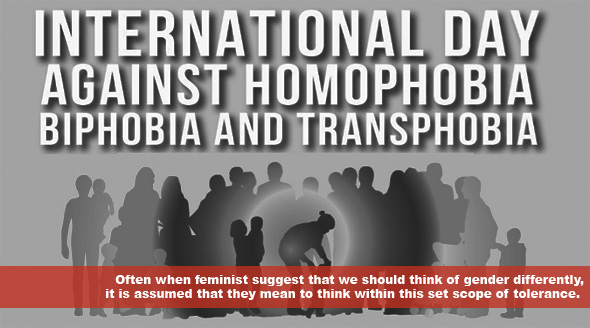
Building alliances between IDAHOT and MaputoProtocol@15 for womxn


IDAHOT:
The international Day Against Homophobia Transphobia and Biphobia

Maputo Protocol:
Protocol to the African Charter on Human and Peoples’ Rights on the Rights of Women in Africa

Womxn:
No set definition. This term, as used in this piece, refers to a broad still unraveling category of persons of female gender who voluntary identify, live, express their gender crossing stereotypical roles and standards, embracing her several cross-cutting circumstances and layers of identity, recognizing the humanity and diversity in her community, operating, demanding, believing in and working towards the substantive equality(equity) of all sexes and genders and against the repressive confines of the poisonous glorification of masculinity at the expense of the human rights of persons of female gender in all spaces. A feminist.


People around the world celebrate IDAHOT annually on May 17 to mark the ‘de-pathologisation’ of same-sex attraction in 1990. 28 years later, in 2018 the African continent celebrates the 15thanniversary of the emergence of the Maputo Protocol, Africa’s regional articulation of the human rights of persons of female gender taking particular cognisance of the African context. Theme for IDAHOT this year is ‘Alliances for Solidarity’, focusing on the important collaborations that have been and need to be forged in laws, policies, theories, practices, movements and relationships in order to foster cut-throat progress in the advancement of human rights, particularly the protection, promotion and fulfilment of the human rights of LGBTI persons. Linking the Maputo Protocol, IDAHOT and their camps as allies I believe is a match made in heaven for the aid of vulnerable groups such as womxn.


In 2015 Caitlyn Jenner rocked most of the world by stepping into public glare to broadcast her transitioning from the widely celebrated athletic and ultra-masculine Bruce Jenner to the now sultry, unsettling, ‘who-do-you-think-you-are’; gracefully disruptive sensation Caitlyn Jenner. ‘This is taking gay to a whole new level!’ the world may have thought- I may have thought so too at the time. Some distance away from Caitlyn’s situation, in spaces like East and West Africa – and even some parts of the South- the noose was tightening legally around persons of same-sex loving sexual orientations and socially around anything that connected to or smacked of derogation from the glorification of heterosexuality and stereotypically set expressions of gender.


At home in Nigeria, it was such a heated time, it is still very heated at the moment. In some parts of Nigeria, actual or perceived homosexual sexual orientation could land persons and groups serious beatings, lynching, unlawful arrests, public humiliation in the media and even death. The flame of this homophobic inhumanity is fanned by the media, pop-culture, religious and political leaders. In South Africa, where I now reside, where the laws are progressive and the expectations are high, there are still recurring incidents of homophobic human rights violations.


Unfortunately, because the general and uninformed impulse is to flatten everything that is not heterosexuality to homosexuality, this translates to lived realities getting several times as hard and repressed for womxn, for the multiple reasons that: they are persons of female gender; they cross de-glorifying constructs of socially and culturally set standards of femininity and poisonously glorified masculinity in all spaces; there is often a strict expectation that womxn should not be doing the latter; womxn breaching this expectation is perceived as highly offensive and threatening by persons and systems of authority. As if regular gender inequality was not bad enough, womxn deal with recurring and increasing degrees of gender-based violence, domestic violence, rape, humiliation at work, school, places, of worship, policing of their femininity, their views, careers and bodies. In a greater part of the continent, womxn on a daily basis deal with shocking levels of human rights violations.


In several African societies, there are a thousand and more shades of womxn or persons perceived to be womxn. These range from persons of female gender who choose to wear trousers and not skirts to persons who wear a darker shade of lipstick than others; dying their hair a colour/shade or two varying from the default ; pierce more than one hole on an each ear for jewelry or pierce multiple holes around their body; having tattoos; stubbornly insisting on going to school; pursuing a career as opposed to involuntary staggering into marriage; not being interested in marriage at all; having a deeper note of baritone than is permissible; being sexually and romantically inclined or attracted to or involved with other persons of female gender; having social, genetic, genital or physical features that are outside poisonously glorifying masculine expectations of what a person of female gender should be. But this is not the only problem.


In 2017, Chimamanda Ngozi Adichie, award winning Nigerian author whose feminism is often woke, made the controversial statement ‘Transwomen are transwomen’. This earned her so much hostility. She subsequently explained that she meant to say that transwomen are separate category with unique experiences from naturally cisgender women. More interestingly this controversy highlighted the argument that more often than not feminism is largely pegged on the tokenisation of female persons whose gender identities and expressions are reasonably within the scope of tolerance of the masculine glorifying structures, enough to matter as the majority of persons of female gender , and often as the only persons of female gender that count.


Generally, in most African societies and at the regional level, womxn do not fall within this scope of tolerance as such they have been unjustly excluded from the broad and open conversations on gender and human rights. Contrary to Chimamanda’s inclinations of separating the different struggles in order to keep them all in focus, the plight of womxn have been separated and ignored. Separation has not worked. Perhaps this is because gender and human rights on the African continent still generally caters to poisonously glorifying masculine standards.


Often when feminist suggest that we should think of gender differently, it is assumed that they mean to think within this set scope of tolerance. The wide resistance to the observer status of the Coalition of African Lesbians (CAL) should also have been perceived as a bold and unjust resistance to the substance of the Maputo Protocol and the human rights of persons of female gender on the African continent. A resistance that all persons of female gender, and everyone else should recognise as a disappointment and threat to human rights and democracy.


The Centre for Human Rights recognises this resistance and is presently working on a visual campaign with the theme of ‘Transwomen are women’ to mark the 15th anniversary of the Maputo Protocol. This campaign argues for respect for diversity and the recognition of the plight of womxn as part of the major issues that concern persons of female gender on the African continent. This is because a person of female gender is never just one thing. This campaign encourages that the articulation, policy making, law making, activism and positive practices around the human rights of persons of female gender be enriched to include and cater for the human rights and specific identities and realaties of womxn as well. The stars align in Africa, allying IDAHOT and MaputoProtocol@15, we need to think and work inclusively, progressively and productively for all persons of the female gender; nobody should be ignored. Nobody should be left behind.


(Originally punblished on: https://africlaw.com/2018/05/18/building-alliances-between-idahot-and-maputoprotocol15-for-womxn/ )

Friday, 9 February 2018

'Unbeautiful', Njo!

Sometimes it invades me like fever
'Unbeautiful',  'Njo!' I feel it.
It comes at night to assault me
His arms are cold and infuses me with sadness
I can't sleep
No one at home can sleep
My bed creaks 
I pace about restlessly in my mind
I hear words and faces are formed in the virtual clay of the dark
I see pictures even
'Unworthy', how can I forget?
Then the morning comes
And I emerge like I'm happy, who doesn't
I forget that I'm pretend, I believe, faith
There isn't a reason not to be
But I'm ashamed
I'm deeply ashamed
I can't tell anyone
They hear the creaking beds not my screaming
'Unneeded' 'such a waste'
The whispering never stops in my head and in the corridors
I've failed at 'boyhood'
I've failed at 'manhood'
There is nowhere to run to
The floor has denied me a funeral
The sun blares overhead
The heat is lethal
It hurts me, us
And when it rains, it floods
It floods cold puddles of tears
It's dark only to be lit by the scary lightening that winks at my humiliation
It's bed time again
'Unbeautiful', 'Alu!' 'such a waste' 
The voices return
I can't sleep
No one at home can sleep
So we lay alive in our beds, in the puddle of tears that fell as rain 

Wednesday, 20 December 2017

Blue


Blue is the colour of denim.  It is the colour of ‘cakes’ and condoms. It is the colour of Nkosi’s charm when he twists and turns beside me. I am leaving him in the morning for Nigeria. Our Hatfield home is all I have known for the past seven months. I love it. I love him. But home is where my butt was first whipped, Port Harcourt Nigeria. It is where green is still dense and needs no artificial watering. Home is where pap is not a thick corn paste eaten with chicken but the thin akamu lapped up with sugar, milk and moi-moi. 

But blue is the colour of our bedsheets too. It is the colour of the plastic horn Nkosi wears around his neck. Blue is the colour of Nkosi’s love. The colour of the shirt he wore the day we locked glances for the first time at a cocktail bar eight months ago. I shivered because it had been cold. But I shuddered because I had never thought myself queer enough to catch anyone’s attention. But he had seen me. Nkosi had seen me and had come to me. 

Blue, the colour of my turbulent blood and the frozen time when he held me in the space between the Joe Public night club and a raging heart, kissing and tickling my ear lobes so tenderly as his caucasian un-Zulu looking fingers held my torso in place.

Blue is often the colour on the insides of my closed lids as I, stark naked, ride his lips, while he lay slabbed between and beneath me fully clothed, drenched in our sweat.  All the while, his wide pelvis oscillating gently beneath the gentle press of both his palms. All the while still clothed.  So blue. So Nkosi.

Blue, the colour of the condom he handed me just before I fucked my thirtieth birthday present while he laid back on the grey velvet sofa puffing the cigar that he lit in the flicker of the scented candle beside him. All the while laid back stringing me tightly with his eyes, his saturating presence.
Blue, the colour of the pills he swallows at 8:00pm every night just after dinner. I serve him on a glass saucer. His eyes, half shut like Garfield's after gulping them down. He regrets. But things are better. 

I am leaving him in the morning for Nigeria. It is my nephew’s christening in a few days. I have been chosen to be his godfather. This will be my first visit to Nigeria since I told my family during our monthly skype call that I like boys that much. Blue was the colour of their silence. And the colour of the screen when they all feigned poor internet signals and signed off one after the other. They had not fought me but they had avoided talking about it. Blue is the colour of the emptiness I felt, I still feel.
I am boy. ‘Blue is for boys.’ This had always been drummed into me from birth whenever I had to choose anything from a toothbrush to a shirt, anything. So everything had to be blue, a different shade of blue, but blue. Blue is the colour of everything that I have learned to cling to. Blue is my fierce pull to Nkosi, a man almost like me. Blue is my fever. 

Blue makes me cringe at the Nigerian label tibii  and makes me embrace the South African label queer. Being tibii makes me a target but being queer validates my agitation, lets me stand behind ideologies and philosophies, walls that insulate me from stones and raw homophobia. Blue makes it okay to be insulated. I am insulated. Nkosi is not. He was born with a vulva that he will let no one touch. His vulva had annoyed me in the first month. 

‘This is simply impossible!’, I thought while my car sped away the night he told me.

It had frightened me for the better part of our second month together. I could not imagine myself sharing a home or a life with it. But Nkosi…Nkosi drove me ga-ga. He drove me kpof-corns. I stayed.  I learned to stay and grow into every part of him. Not that I mind, but somehow here in South Africa it is a big deal that his blood screams of Zulu, Afrikaans and English genetic scripts yet his skin and hair are European. He wants his skin several shades darker. He is not insulated, he may never be.
 He turns and turns beside me. His face marked by last night’s tears. His lips mumbling in his sleep the last of his plight to me. He does not want me to leave. He wants to come with. He said that he has a bad feeling about my return home. He thinks that it is a trap.

 'Tope, I have a bad feelings', he says.

 He believes that he will never see me again. He cried himself to sleep when I failed at being ‘reasonable’.

I am scared of returning home. But home is where my butt was first whipped. So I am all packed and ready to hop on that plane to return to the place where I can be uncle, son, brother. These make Nigeria worth returning to. I am not scared enough to forget. I am resolved to never be that scared. At least not yet. 

Sirens blare and someone in a blue shirt screams ‘homo!!!!’ and my lids are flung apart. ‘Jesus!’
‘I’m sorry’ she texted in a Whatsapp message just before I boarded. ‘Ejike says that his son will have no cock-sucker for a godfather. I’m sorry.’  Still, I am allowed to come home. They have said nothing else. They not told me that they joined some our church members to hold private prayer sessions for me. They have not told me that they have ransacked my room in search of proof. Proof! They had not told me that they have been questioning my friends and physically attacking them whenever they visited our home. They been quiet and courteous to me. Sending me their love and blessings.
Still I am boarding the plane, oblivious of the 42 men arrested only a few months ago for homosexual charges. The plane is packed with Nigerians, mostly Igbo men like me. I can tell, they have their blue walls up claiming their space, asserting themselves in shades of blue, from cocky loud to silent deadly. Blue!
I am going home. Nkosi is in my thoughts. I am scared. As the plane leaves the ground I regret. I want to varnish. I want Nkosi.

Sunday, 17 December 2017

Because Amasa Firdaus Abdulsalam stands: An open letter to the Nigerian leadership and people requesting the unconditional call of Amasa Firdaus Abdulsalam

Dear Naija,

On 12 December 2017, a batch of Nigerian law students were admitted at the International Conference Centre(ICC), Abuja to the Nigerian Bar as barristers and solicitors of the Supreme Court of the Federal Republic of Nigeria. I recall thinking, in 2015 when I was called, that the my call was the biggest party in Abuja and possibly Nigeria. This is because at every call the world would be alive to watch the Nigerian law students' six or more years of study validated by the creme de la creme of the Nigerian legal profession.

I assure you, it is a big deal not just for the law student, but also peers, family, community and the rest of Nigeria.

At the 2017 call, Amasa Firdaus Abdulsalam, a young female muslim law student, was denied entrance into the ICC because she insisted on wearing the muslim hijab beneath her wig.  On the grounds of her visibly identifying as a muslim, she was denied her well deserved admittance into the Nigerian Bar. This denial is completely unacceptable. Section 38 of the Constitution of the Federal Republic of Nigeria 1999(as amended) which provides for the freedom of thought, conscience and religion frowns at it.  So does Article 3, 5 and 12 of the Protocol to the African Charter  on  Human Rights on the Rights of Women in Africa which provide for the rights to dignity and state duty to eliminate all forms of harmful practices which negtively affect the human rights of women; protect women who are at risk of being subjected to harmful practices or all other forms of intolerance; protect women from all forms of abuse in school(academic pursuit); Article 6, 23(g), 25 of the African Youth Charter which provide that states shall ensure that every young person shall have the freedom of thought, conscience and religion; eliminate all traditional practices that undermine the physical integrity and  dignity of women; provide educational sytems that do not impede girls from attending, eliminate harmful social and cultural practices that harm and are discriminatory to youth on the basis of gender, age, or other status; Article 4,5 and 8 of Nigeria's African Charter on the Human and Peoples' Rights Ratification and Enforcement Act (African Charter) which provide for the right to inegrity, dignity and the free practice of religion frown at this.

Amasa Firdaus Abdulsalam
As always the social media and the real society has diverging stance on the issue of whether or not the system is legit in its withholding Amasa's acceptance into the Nigerian Bar on the basis of her insistence on wearing her hijab while being called. However, it is important to consider precedents on the interpretation of freedom of religion. The African Charter, though an international treaty, has been domesticated in Nigeria as a federal law and is as binding as every other federal law in Nigeria. Articles 61 of the African Charter permits that to interprete its provision, inspiration may be  drawn from legal principles, precedents, doctrines, customs generally accepted as law and recognised by African states. In this light, the decision of the African Commission on Human and Peoples' Rights (African Commission) on the scope of the freedom of  religion are a relelvant reference. Prince v South Africa (2000) AHRLR 57 (ACHPR 1997).

In Prince v South Africa the African Commission addressed among other things the scope of freedom of freedom of religion and its limitation. In this case, Prince argued that his freedom of religion was violated because the South African government denied him admittance into his legal profession on the basis of his use of cannabis (although for sacremental purpose as a Rastafari). The use of cannabis is generally illegalised by the South African Drugs and Drug Trafficking Act. He was made to choose between adhering to his Rastafarian beliefs and his professional career as a lawyer.

The African Commission in addressing the limitations of freedoms enshrined in Art 27(2) of the African Charter, held that human rights and freedoms may be restricted by the state. However, such limitation must be strictly proportionate  with, and absolutely necessary for the advantages, which are obtained. These advantanges include protecting the rights of others, collective security, morality and common interest. In Prince's case, restricting his freedom of religion based on his use of cannabis was legitimated based on the fact that cannabis is an 'undesirable  dependence producing substance'.

A similar restriction, as relied on the African Commission in Prince's case, was held by United Nations Human Rights Committee in K Singh Bhinder v Canada (communication 208/1986). In this case Bhinder, a maintenance electrician at a government owned Canadian National Railway Company, insisted on wearinga turban as prescribed by the Sikh religion as opposed to a safety head gear at work. Owing to this, his employment was terminated. Bhinder alleged discrimination. The Committee, in interpreting the Article 26 International Covenant on Civil and Political Rights(ICCPR)(on the rights to equality and non-discrimination) held that the law's requirement of wearing a safety head gear in employment  such as Bhinder's was 'reasonable and directed towards objective purposes that are compatible with the ICCPR, human rights, life, dignity, equality, safety...

The four principles are afloat here are those of proportionality, necessity, reasonability and legality.  Is there a particular ill that wearing the hijab resorts to? Does it violate anyone else's human rights? What purpose does the insistence of the management on Amasa's refusal to take off the hijab serve? Was it necessary for the protection of public morality or safety? Did Amasa's wearing the hijab violate any rule or law? Even if it violated a rule or law, how compatible is that rule or law with the pursuit of the welfare of the Nigerian people, the legal profession or human dignity generally? How reasonable was Amasa's being denied admittance into the legal profession on the basis of her insistence on being called wearing her hijab? If these questions and issues are thoroughly considered, we see that there was absolutely no legit basis for Amasa's being denied admittance into the Nigerian Bar.

The hijab is no cannabis; wearing it to the call to bar ceremony does not infringe on the collective security, morality or right of others like was the case in Prince v South Africa. It has absolutely no safety implication and violates no just legal requirement which exists in cognisance of the humanity, dignity and human rights as was the case in K Singh Bhinder v Canada. Refusing Amasa admittance to the Nigerian Bar on the grounds of her wearing her hijab is of no necessity besides fostering a practice that serves no essential purpose outside falsely role casting the Nigerian legal profession and the rest of Nigeria as a homogenous common law jurisdiction. What has been done to Amasa is totally unacceptable and is against the principles of proportionality, necessity, reasonability and legality.

Granted, Amasa's insistence on wearing the hijab is 'transgressive'. But  even in her seeming transgression she is well within the scope of her freedoms of expression and religion. Have not our legal history shown us that such 'transgressions'  are more salient than cowering silence and compliance, and should be more welcome than not? This is especially in a Nigeria where patriachy and inequality mostly go unquestioned, unjust conventions and practices mostly progress undisturbed. Undisturbed, untransgressed! Unjust practices which span from the ancestral era of slavery, colonialism and the killing of twins to the more contemporary ones such as the preclusion of female offsprings from inheriting family property, ruled against in Mojekwu v Mojekwu (1997); the requirement that married Nigerian women must provide the authorisation letters from their husbands while applying for a new international passport, ruled against in Dr Priye Iyalla-Amadi v Comptroller General, Nigerian Immigration Service and Anor (2009); the mob attacks inflicted on suspected homosexuals in Nigeria which still thrive unattended; unquestioned excesses by members of the police force. I could go on.

But, but, but, Amasa has not only decided to speak and act up, she has, through her firm stand, cast a light on Nigeria's greatest sin, intolerance. Nigeria is more than just a former british colony, it is a diverse territory overflowing with all sorts which the Nigerian state is bound by laws both national and international to protect, preserve and inclusively balance. We are anything, everything,  but homogenous. The fact that 'this is how it has been' is no longer good enough to secure our development as a people. We can test this against history, the past, against our hopes and dreams for our country, our youth, our future. There is a space for Amasa and her message at the Nigerian Bar. There is a space for diversity and inclusion in Nigeria.

The call is such a symbolic ceremony for every Nigerian lawyer because it is an ushering into a life time career of speaking up and standing out. Most of us may never get to do this even after being called. Amasa, however, decided to begin her career with her call ceremony. What has been done to her is a great injustice. It will even be a greater injustice to stall her career for another year. There is no greater humiliation than this. This humiliation shall poison our youth with cowardice and fill our streets with impunity.

As a queer Nigerian man who understands the evil of intolerance and the repression of unquestioned conventions, I join my voice with Amasa Firdaus Abdulsalam, and several others, to demand the following from the leadership of  the Nigerian Law School,  Council of Legal Education and Nigeria:

1. The revisiting of the dresscode for the Nigerian Law School and Call to Bar ceremonies to include the wearing of hijabs;

2. A public apology  to Amasa Firdaus Abdulsalam for denying her admittance, alongside her peers, into the Nigerian Bar on 12 December 2017;

3. That Amasa Firdaus Abdulsalam be called to the Nigerian bar with all the due rights and privileges conferred on her.

4. That the fulfiment of the above request (3) be deemed, for all intentions and purposes, to have been done on 12 December 2017 as was the right date of her call.

I celebrate you Amasa Firdaus Abdulsalam. I stand with you. Your ruggedity has begun a stampede. You are on to great things.

Inspired,
Nnanna

(I write this is in my capacities as a Nigerian lawyer and storyteller, none other)

 (Amasa Firdaus Abdulsalam's image source from http://www.aljazeera.com/news/2017/12/nigerian-law-graduate-denied-call-bar-hijab-171216084329791.html)

Odogwu is not mine, I think

  Dear Nnanna, Good morning. Kedu? It is not often that I write because the life of a newlywed is quite the project. Unfortunately, the hone...